
Homes, lake houses, shops and barns in Hopkins County
Spray Foam Insulation in Sulphur Springs, TX
Foam where it earns its cost, blown-in where it does the same job for less, and a written price for each area.
- Free on-site estimates
- Foam type, inches and R-value listed for every area
- Leaks, damp wood and duct problems pointed out before we insulate
Insulation Built for Northeast Texas Summers
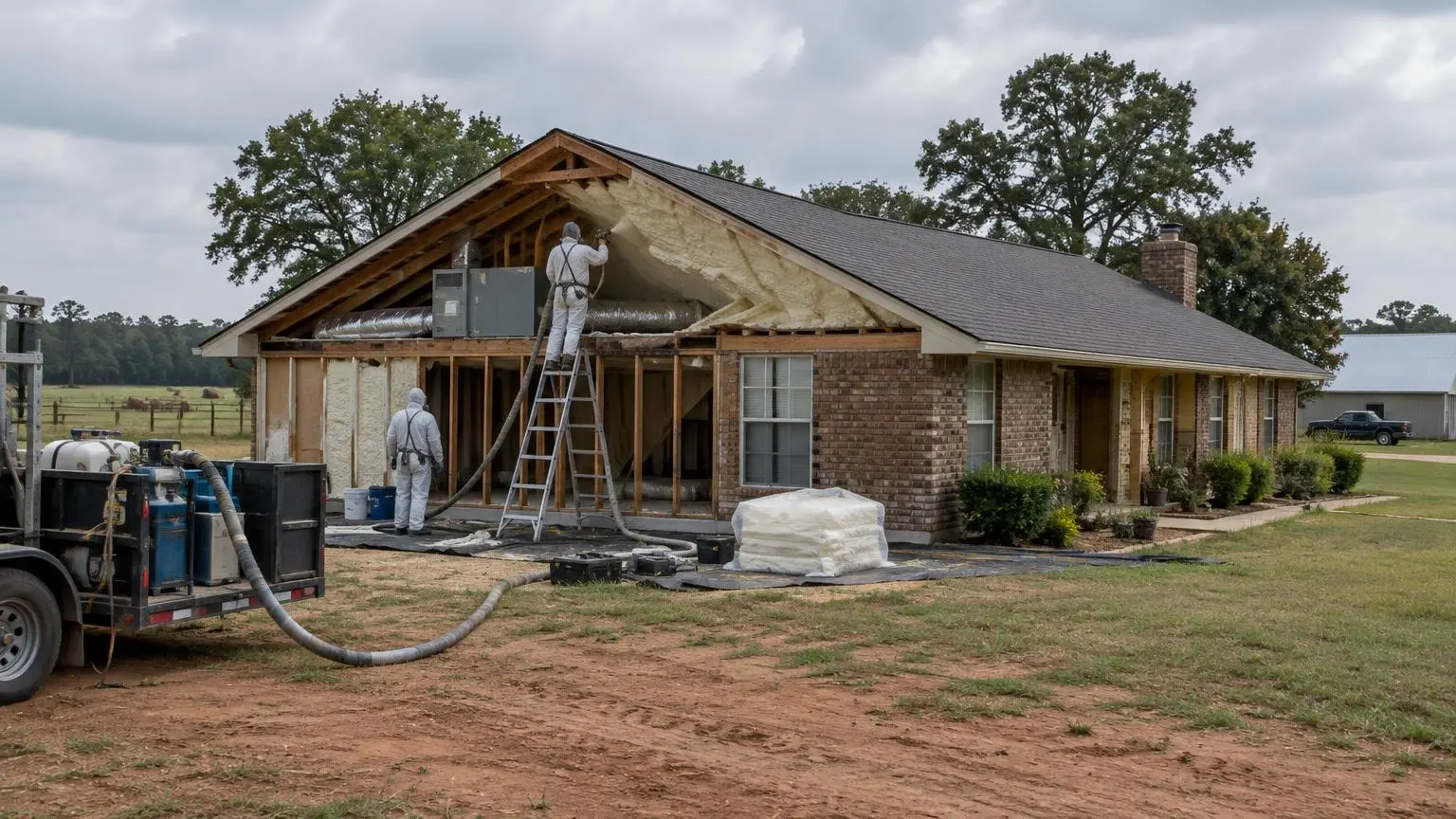
Spray foam insulation in Sulphur Springs earns its keep in July and August. The city's 1991-2020 climate normals on Wikipedia show an average daily high of 94.2F in July and 94.9F in August, a record of 115F, and about 46.5 inches of rain a year in a humid subtropical climate. That means a long cooling season with sticky air, and an attic overhead that bakes from late spring into fall. We seal and insulate attics, walls, raised floors, shops and barns with open-cell or closed-cell foam where foam is the right fit, and with blown-in cellulose or fiberglass where that gets the same comfort for less money.
Winter still counts here
Sulphur Springs is not South Texas. The same climate table lists an average January low of 34.0F and a record low of -12F, and Northeast Texas gets the occasional ice storm. A house that leaks air in August also leaks it in January, and pier-and-beam floors over open crawl spaces feel it first. Good insulation and air sealing work in both directions: they keep the AC from running all afternoon and keep pipes and floors from getting as cold during a hard freeze.
What the energy code asks for in Hopkins County
Hopkins County is in Climate Zone 3A, the warm-humid band that covers most of Northeast Texas, according to the county list kept by OpenEI. Texas set the 2015 International Residential Code, Chapter 11, as its statewide energy standard for houses starting September 1, 2016, according to the State Energy Conservation Office. Under that code, a summary from the Insulation Institute lists R-38 for ceilings in Zone 3, R-20 or R-13 plus R-5 continuous for wood-frame walls, and R-13 or R-5 continuous for crawl space walls. Cities can adopt a newer code, so we check with the local building office when a permit is involved. For existing houses, ENERGY STAR recommends R-49 in an uninsulated Zone 3 attic and R-38 added where three to four inches already sit on the floor, plus R-19 under floors.
What we see in local houses
Sulphur Springs has been the Hopkins County seat since 1871, and the 2020 census counted 6,966 housing units in the city. The housing runs from older frame homes around the square to mid-century brick ranches, newer subdivisions and homes on acreage outside town. Across the county, 68.9% of occupied homes are owner-occupied. The common problems are the same across those eras: thin or settled attic insulation, gaps around plumbing stacks, wiring, light fixtures and the attic hatch, ducts and an air handler sitting in a hot attic, and raised floors with little or nothing under them.
Closed cell vs open cell
Open-cell foam is soft and light. HomeGuide rates it at about R-3.5 to R-3.7 per inch. It expands to fill rafter bays and wall cavities, stops air well and costs less per inch, so it is the usual pick for the underside of a roof deck when we turn the attic into a sealed space. Closed-cell foam is dense and rigid, about R-5 to R-7 per inch per HomeGuide, and at normal thickness it slows water vapor and shrugs off moisture. We use it on steel walls and roofs of metal buildings, under raised floors, at rim boards and in tight spots where only an inch or two fits. Your quote names the foam for each area and the reason.
Spray foam vs blown-in for the attic
Foam is not always the answer. If the ducts are inside the house and the attic floor is open and easy to reach, sealing the ceiling and blowing cellulose or fiberglass deep across it usually costs much less per R-value. If the ducts and air handler live in the attic, which is common here, moving the insulation to the roof deck with spray foam puts that equipment inside the sealed space instead of in the heat. When both make sense, we price both side by side.
Spray foam insulation cost
HomeGuide's 2026 guide puts installed spray foam at $1.50 to $5.00 per square foot: open-cell at $1.50 to $3.50 and closed-cell at $3.00 to $5.00. It lists a spray foam attic at $3,000 to $8,000 and a whole house at $8,000 to $20,000, and notes many crews set a minimum of $1,000 to $2,000 or more. Fixr's 2025 guide shows $3.15 to $7.50 per square foot for existing walls and $2.75 to $6.50 for new construction. Blown-in runs $1.00 to $2.80 per square foot in HomeGuide's guide. Foam is often priced by the board foot, one square foot one inch thick, so two inches over 1,000 square feet is 2,000 board feet. These are national numbers for budgeting; the figure on your written estimate is what you pay.
Rebates to check before you sign
Oncor delivers electricity in Sulphur Springs, and Oncor says it pays incentives to participating service providers for upgrades such as added attic insulation, with residential programs usually running February through November while funds last. Use Oncor's service provider lookup to see who qualifies before the job starts. Farmers Electric Cooperative, which serves rural areas west of town, lists energy efficiency rebates for its residential members capped at $500 per membership a year; call the co-op to ask whether insulation qualifies.
How to compare insulation contractors and spray foam companies
When you get quotes from spray foam insulation contractors or other insulation companies around Sulphur Springs, ask the same questions of each one. Which foam goes where, and how many inches? What R-value does that give? How will they handle the attic vents if they seal the roof deck? What ignition or thermal barrier does the foam need where it is exposed? How long does everyone stay out while it cures? HomeGuide advises at least 24 hours. A quote that lists one total with no thickness or R-value is hard to compare, so ask for the details. Ours lists them by default.
Towns We Serve Around Sulphur Springs
We work in Sulphur Springs and Cumby in Hopkins County; Mount Vernon in Franklin County near Lake Cypress Springs; Winnsboro, Quitman and Yantis in Wood County around Lake Fork; Emory in Rains County; Cooper in Delta County; Commerce and Greenville in Hunt County; Mount Pleasant in Titus County; Pittsburg in Camp County; and Paris in Lamar County. The county seats hold a lot of older frame and brick houses, the lake towns hold weekend houses and cabins, and the farm country between them is full of shops, barns and metal buildings. Each town page covers what is different there.
- Spray Foam Insulation in Sulphur Springs, TX
- Spray Foam Insulation in Cumby, TX
- Spray Foam Insulation in Mount Vernon, TX
- Spray Foam Insulation in Winnsboro, TX
- Spray Foam Insulation in Quitman, TX
- Spray Foam Insulation in Yantis, TX
- Spray Foam Insulation in Emory, TX
- Spray Foam Insulation in Cooper, TX
- Spray Foam Insulation in Commerce, TX
- Spray Foam Insulation in Greenville, TX
- Spray Foam Insulation in Mount Pleasant, TX
- Spray Foam Insulation in Pittsburg, TX
- Spray Foam Insulation in Paris, TX

Common Questions
How much does 2 inches of spray foam cost?
It depends on the foam and the area. Contractors often price foam by the board foot, one square foot at one inch thick, so 2 inches over 1,000 square feet is 2,000 board feet. HomeGuide's national installed range is $1.50 to $3.50 per square foot for open-cell and $3.00 to $5.00 for closed-cell. Your written estimate lists the inches and the price for each area.
What are the building code requirements for insulation in Texas?
Texas uses the 2015 International Residential Code, Chapter 11, as its statewide energy standard for houses, in effect since September 1, 2016. For Climate Zone 3, which includes Hopkins County, that means R-38 ceilings and R-20 or R-13 plus R-5 continuous in wood-frame walls. Some cities adopt newer codes, so check with the local building office on permitted work.
Is spray foam insulation flammable after it dries?
Cured foam is a plastic and it will burn, which is why the residential code requires a thermal barrier such as half-inch drywall between foam and living space, and an ignition barrier in many attics and crawl spaces. We tell you which applies to each area and include it in the quote when it is needed.
Who makes spray foam insulation?
Several chemical companies make two-part foam systems in both open-cell and closed-cell versions. We name the product on your quote and can give you its data sheet, which lists the R-value per inch and the barrier rules for that foam.
Should I use closed cell or open cell spray foam in Sulphur Springs?
Open-cell is the usual choice under the roof deck of a sealed attic and inside walls, because it fills the space for less money. Closed-cell suits metal buildings, raised floors and tight spots, because it is denser, higher in R-value per inch and slows moisture.
How long do we need to be out of the house?
HomeGuide advises staying out for at least 24 hours while spray foam cures. We ventilate the work area and give you a time to come back when we schedule the job.
Is spray foam worth it on a metal shop or barn?
Often, yes. Closed-cell foam on bare steel stops the dripping that happens when warm, humid air hits cold metal, and it slows heat through a roof that sits in full sun. If the building is only for storage, a thinner coat may be enough, and we will say so.
Our Services
Six kinds of insulation work, from foam on roof decks and steel walls to clearing out old insulation that has had its day.
Spray Foam Insulation
Open-cell or closed-cell foam that seals air leaks and insulates in one layer on roof decks, walls, floors and steel.
Learn more →Attic Insulation & Air Sealing
Sealing the leaks in the ceiling, then bringing the attic up to a real R-value with blown-in or foam.
Learn more →Shop, Barn & Metal Building Insulation
Closed-cell foam on steel walls and roofs to stop sweating, slow the heat and make a shop usable year-round.
Learn more →Crawl Space & Pier-and-Beam Insulation
Insulating and sealing under raised floors so older houses and lake cabins stop feeling cold underfoot.
Learn more →Blown-In Insulation
Loose-fill cellulose or fiberglass blown into attics and closed walls, the low-cost way to a high R-value.
Learn more →Old Insulation Removal
Vacuuming out wet, matted or contaminated insulation so the attic or crawl space can be cleaned, sealed and redone.
Learn more →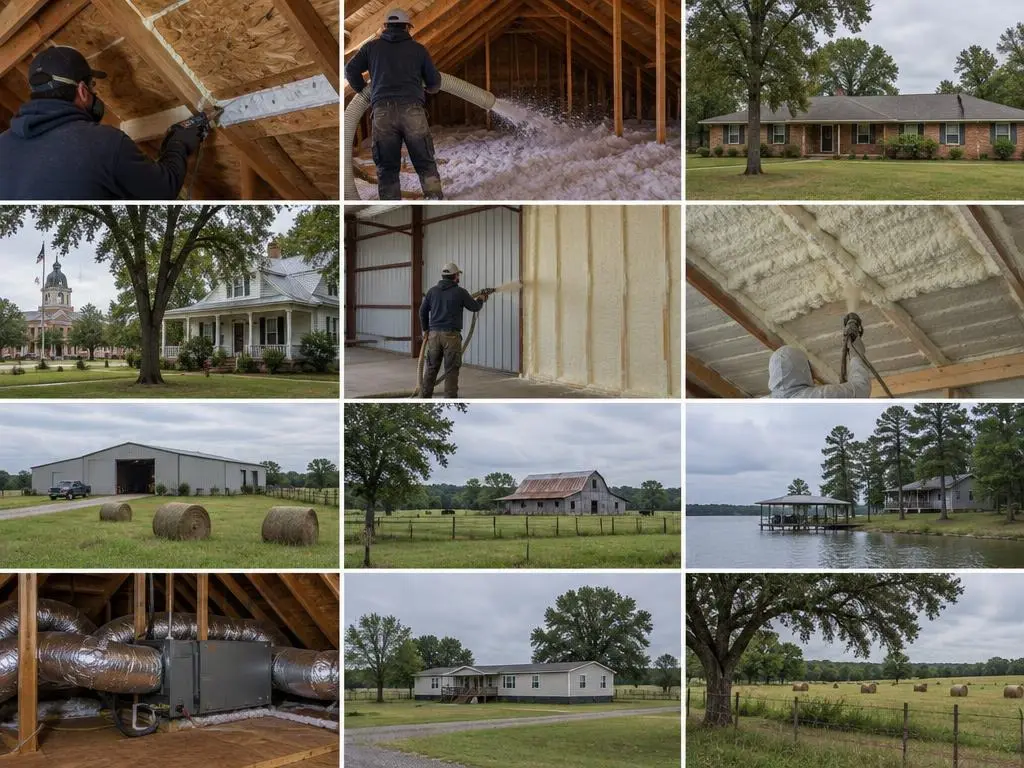
Why Homeowners Call Spray Foam Insulation Sulphur Springs
We see it before we price it
Every quote follows a visit to the attic, the crawl space or the building. No numbers sight unseen.
Ducts get factored in
Where your air handler and ducts sit decides whether a sealed attic or a sealed ceiling makes more sense, so we check first.
Barns and shops welcome
Metal buildings, shops and barns get a spec written for steel, condensation and how the building is used.
Quotes you can line up
Each area shows material, thickness or depth, R-value and price on its own line.
Get a Spray Foam Insulation Estimate in Sulphur Springs
We come out, look at the attic and the rest of the building, and send a written price with material and R-value for each area.